 Beer Galaxy
A pint of beer (50 cl) contains on average 180 to 260 calories, depending on its alcohol content. A light beer (4 % ABV) provides about 180 kcal, a standard lager (5 %) around 220 kcal, and a strong beer (7-8 %) can exceed 300 kcal. Alcohol accounts for 60 to 80 % of these calories, the rest coming from residual sugars.
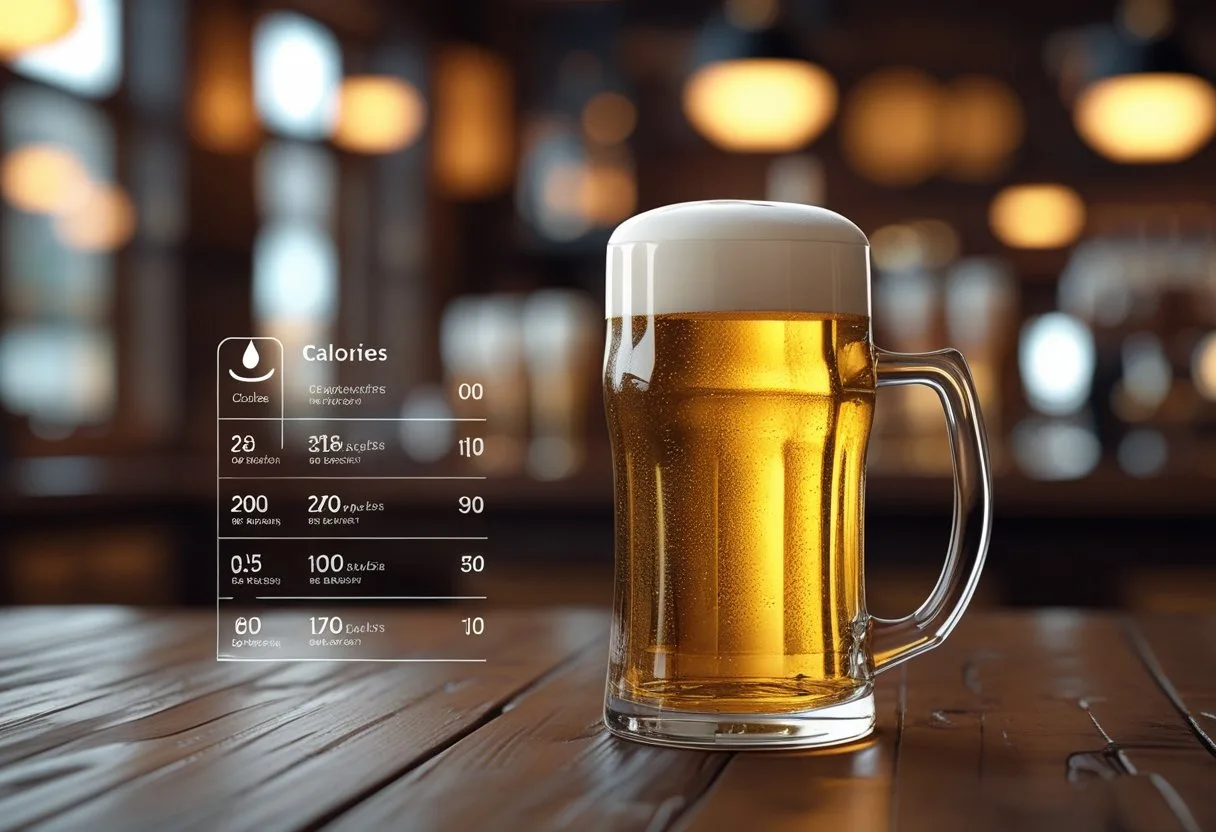
Understanding where calories come from helps you make better choices about what you consume. Alcohol remains the main factor, but the type of beer, ingredients and brewing process also play a role.
A light lager does not contain the same number of calories as a strong craft beer or a stout rich in residual sugars.
How many calories are there in a pint of beer?
How many calories in 1, 2, 3, 4 or 5 pints of beer?
A UK pint (568 ml) of standard beer contains roughly 215 kcal, so the calories add up fast across a session: two pints ≈ 430 kcal, three ≈ 645 kcal, four ≈ 860 kcal and five ≈ 1,075 kcal. A US pint (473 ml) is smaller, around 180 kcal. These are averages for a 4–5% beer; stronger ales and stouts push each figure higher.
| Number of pints (UK, 568 ml) | Approx. calories (4-5% beer) |
|---|---|
| 1 pint | ~215 kcal |
| 2 pints | ~430 kcal |
| 3 pints | ~645 kcal |
| 4 pints | ~860 kcal |
| 5 pints | ~1,075 kcal |
For reference, a UK pint is 568 ml, a US pint 473 ml, and a European pinte is usually 50 cl. To convert any volume, count roughly 38–45 kcal per 100 ml of standard beer. See also our breakdown of beer calories by serving size.
A pint of beer contains a significant amount of calories. The volume, alcohol content and ingredients cause this amount to vary.
Definition of a pint of beer
In France, a pint of beer is 50 cl (500 ml). In the United Kingdom, a pint is 568 ml.
This difference in volume directly affects the number of calories consumed. A pint of beer therefore contains more calories than a half pint (25 cl) or a standard 33 cl bottle.
For example, a beer with 43 kcal per 100 ml provides approximately 215 kcal per 50 cl. It is also important to note that the word ‘pint’ can vary depending on the region and bar.
Some establishments serve slightly different 50 cl pints. To accurately assess the calories, you need to know the exact volume served.
Average calorie estimate
A pint of regular beer contains an average of 200 to 250 kcal. This figure corresponds to a classic lager with 5% alcohol content.
Light beers often contain between 130 and 180 kcal per pint. Stronger beers such as stouts or IPAs can exceed 280 to 300 kcal. One notable exception: dry Irish stouts such as Beamish Irish Stout (4.1% ABV) stay comparatively light despite their dark colour.
Craft beers, which often have a higher alcohol content and residual sugars, generally have a higher calorie count.
Here is a simplified overview:
| Type of beer | Calories per 50 cl (pint) |
|---|---|
| Light beer (~4%) | 130–180 kcal |
| Standard lager | 200–250 kcal |
| IPA / Stout / Amber | 250 – 300+ kcal |
These values remain averages. The recipe and brewing process influence the final result.
Factors influencing calorie content
The alcohol content is the primary factor. Each gram of alcohol provides approximately 7 kcal.
Thus, an 8% beer contains almost twice as many calories as a 4% beer, for the same volume. The carbohydrate content also plays an important role.
Unfermented sugars present after brewing increase the energy value. Some sweet or highly malty beers have a higher calorie content.
The choice of ingredients also influences the calorie content. Hoppy beers and stouts, rich in roasted malt, contain more calories than light lagers.
Craft beers, which are often more complex, also contain more energy compounds. The brewing method is also important.
Prolonged or incomplete fermentation leaves more sugars in the drink. Non-alcoholic beers are often low in calories, containing around 70 to 100 kcal per 33 cl, which reduces the calorie intake per pint.
Origin of calories in beer
The calories in a pint of beer come mainly from alcohol and carbohydrates. Protein accounts for a much smaller proportion.
Their distribution depends on the style of beer, its alcohol content and the brewing process.
Calories from alcohol
Alcohol is the main source of energy in beer. Each gram of ethanol provides approximately 7 kcal.
A classic lager with 5% alcohol contains between 20 and 25 g of alcohol per 50 cl. This represents 140 to 175 kcal from ethanol.
The higher the alcohol content, the higher the calorie count. Strong beers, such as bocks or craft beers with prolonged fermentation, contain more fermentable sugars, which increases the final alcohol content.
That is why a pint of strong beer can exceed 250 to 300 kcal. A light or non-alcoholic beer significantly reduces this calorie content, sometimes to less than 70 kcal per 33 cl.
Calories from carbohydrates
The barley malt used in brewing provides most of the carbohydrates. During fermentation, some of the sugars are converted into alcohol, but a fraction remains unfermented.
Each gram of carbohydrate provides 4 kcal. A standard pint contains approximately 15 to 20 g of carbohydrates, or 60 to 80 kcal.
Sweeter beers, such as certain stouts or flavoured beers, may contain more carbohydrates. The type of malt and the length of fermentation play a key role.
Complete fermentation reduces residual sugars. Partial fermentation leaves more.
These sugars influence not only the calories, but also the sweetness and density of the beer. A light lager contains fewer carbohydrates than an amber or dark beer.
Calories from protein
Beer contains a small amount of protein from the grains used in brewing. Their nutritional role remains limited.
Each gram of protein provides 4 kcal. A pint typically contains 2 to 3 g of protein, or approximately 8 to 12 kcal.
This contribution remains low compared to that of alcohol and carbohydrates. Proteins mainly influence the foam and texture of beer.
Unfiltered or craft beers sometimes retain a little more protein because they do not undergo all the clarification stages.
Impact of beer type on calories
The calorie content of a pint depends mainly on the style of beer and the alcohol content. Colour, ingredients and brewing also influence the amount of carbohydrates.
Blonde beer and wheat beer
Classic lagers, often around 4 to 5% alcohol, provide around 180 to 260 kcal per pint (50 cl). They remain within the average range for beers, as their alcohol content is moderate.
White beers, brewed with wheat, are slightly lower in calories. A pint generally contains 170 to 240 kcal, depending on the recipe and alcohol content.
Their lighter taste does not necessarily mean that they are much lower in energy. They remain similar to blond beers.
Dark beer, stout and porter
Dark beers, as well as stouts and porters, contain more roasted malts. This increases residual sugars and calorie density.
A pint of stout or porter can vary between 220 and 320 kcal, sometimes more for stronger versions. Classic dark beers have a slightly lower calorie content but are still higher in calories than lagers.
Their rich flavour often comes with a higher alcohol content. This directly contributes to the calorie count.
IPA, pale ale and Indian pale ale
IPAs and pale ales are distinguished by a higher hop content and an alcohol content that is often higher than that of lagers. A classic 6% IPA pint can contain 230 to 300 kcal, sometimes more for double IPAs.
Lighter pale ales, around 4 to 5 per cent, have a calorie content closer to that of blondes, at around 180 to 250 kcal. Alcohol content remains the key factor.
Fans of these beers should bear in mind that aromatic intensity often comes with a higher calorie content.
Light beer, strong beer and non-alcoholic beer
Light beers, with a lower alcohol content (3 to 4%), provide around 120 to 180 kcal per pint. They are suitable for those looking to limit their energy intake while still enjoying the taste of beer.
Strong beers, often above 7%, are the most calorific. A pint can easily reach 300 to 500 kcal due to the alcohol and higher residual sugars.
Non-alcoholic beers, on the other hand, are much lower in calories, with 70 to 120 kcal per pint depending on the recipe. They are a lighter option for reducing calorie intake.
Influence of the brewing process
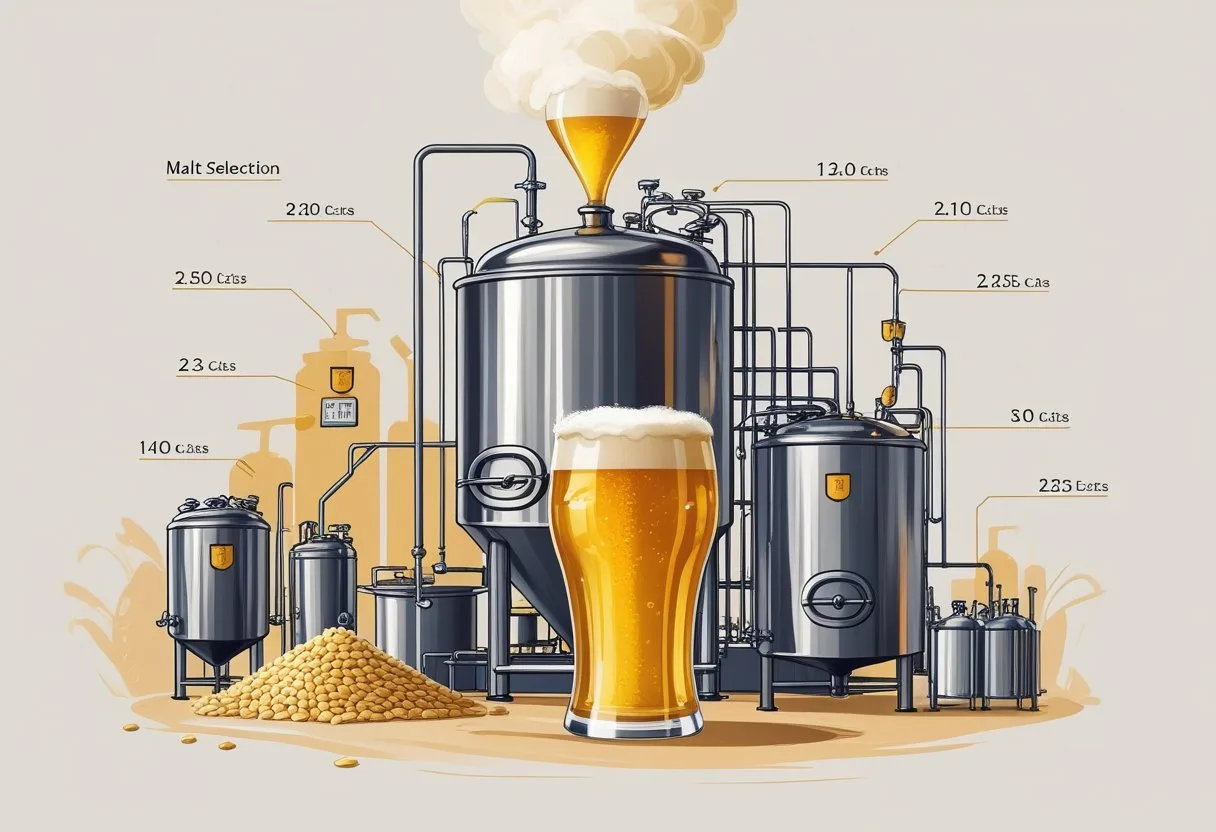
The composition of the beer and the brewing choices determine the number of calories in a pint. The ingredients used and the alcohol content strongly influence the final energy value.
Ingredients and brewing techniques
Raw materials play an essential role. Malt, rich in starch, provides the sugars that are converted into alcohol during fermentation.
The higher the amount of malt, the more residual sugars and therefore calories the beer contains. Hops, used for bitterness and aroma, do not add many calories but influence the perception of taste.
Depending on the strain, yeasts ferment sugars more or less completely, which alters the calorie profile. Brewing techniques also influence the result.
Prolonged fermentation can reduce the remaining sugars. Brewing aimed at preserving a rounder texture leaves more unfermented sugars.
| Element | Impact on calories |
|---|---|
| Malt | Adds sugar → increases calories |
| Hops | Low direct impact |
| Yeast | More or less complete fermentation |
| Fermentation time | Longer = less sugar remaining |
Effect of alcohol content on calories
Alcohol counts for a lot because each gram provides about 7 calories. A 4% beer therefore contains significantly fewer calories than an 8% beer, even though the volume remains the same.
The brewing process determines this rate. More malt in the recipe means more fermentable sugars and therefore more alcohol produced.
This direct link explains why strong beers, such as certain IPAs or stouts, are often higher in calories. There are also differences between beers of the same style.
Incomplete fermentation can leave more unprocessed sugars, which adds calories in addition to alcohol.
Examples of popular beers and their calorie content
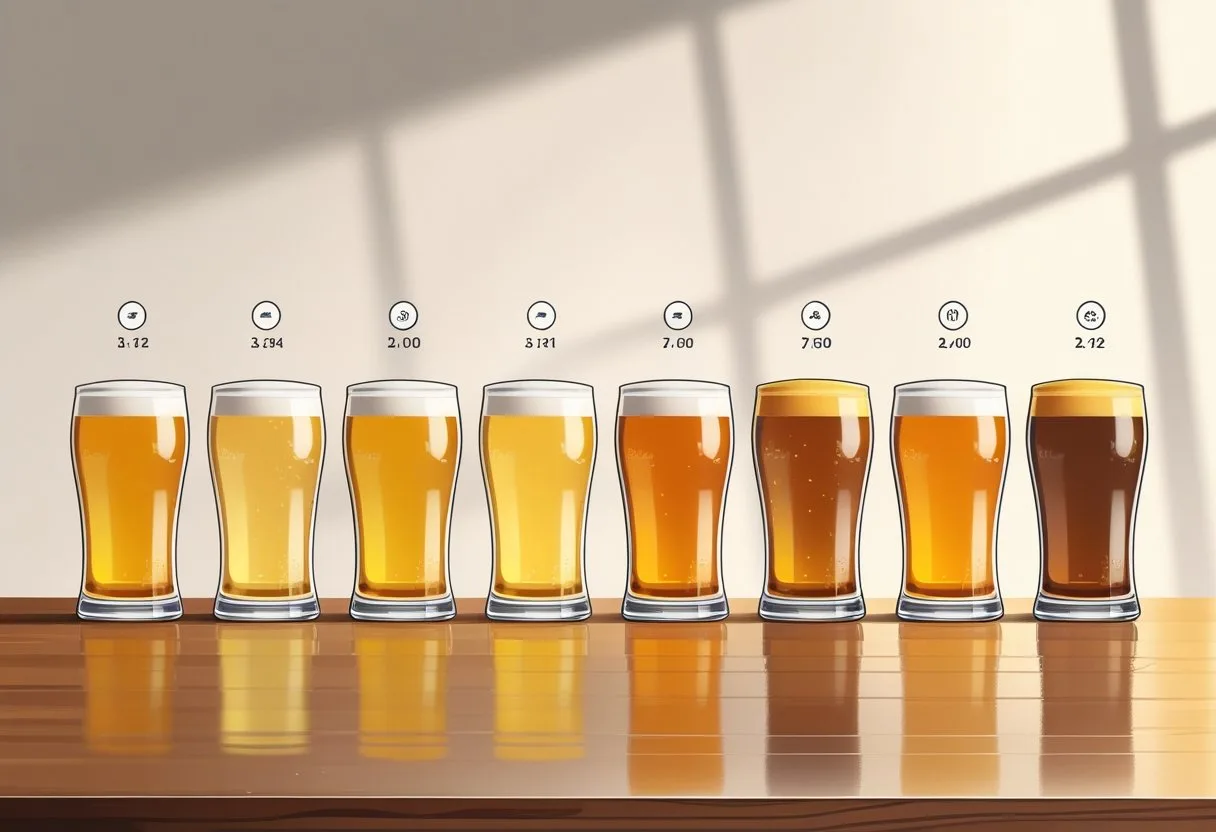
Common beers have fairly similar calorie counts. However, alcohol content and brewing style create differences.
Certain well-known brands serve as a reference for comparing the energy content of a pint.
Heineken and other regular beers
A pint of Heineken (50 cl) contains on average 220 to 250 calories. This value is typical for an ordinary lager with an alcohol content of around 5%.
Similar beers such as Kronenbourg or 1664 are in the same range, often between 200 and 250 calories per 50 cl.
In practice, a 33 cl bottle of this type of beer contains approximately 140 to 160 calories. This corresponds to the energy equivalent of a small snack.
| Beer (volume) | Average calories |
|---|---|
| Heineken 33 cl | 140–160 kcal |
| Heineken 50 cl | 220–250 kcal |
| Regular lager beer 33 cl | 150 kcal |
| Regular lager beer 50 cl | 230 kilocalories |
Comparison between brands and styles
The differences become more apparent when comparing regular beer to other styles. A light beer can be as low as around 100 calories per 33cl, while a non-alcoholic beer often ranges between 70 and 85 calories.
In contrast, a stronger IPA or stout can contain 180 to 200 calories per 33 cl. This represents nearly 300 to 500 calories per pint, depending on the alcohol content.
| Beer style (50 cl) | Average calories |
|---|---|
| Ordinary blonde | 220–250 kcal |
| Lightweight | 150–180 kcal |
| Alcohol-free | 110–130 kcal |
| IPA / Strong stout | 300–500 kcal |
Tips for limiting calories when drinking beer
The alcohol content directly influences the number of calories in a pint. The style, frequency of consumption and serving size also play an important role.
By adjusting these elements, everyone can reduce their calorie intake without giving up beer completely.
Choose lower-calorie beers
A light beer often contains less than 5% alcohol, which reduces its calorie content. For example, a pint of classic lager (around 5% ABV) contains between 180 and 260 calories.
A strong beer can exceed 400 calories. Non-alcoholic beers are an interesting alternative.
A 25 cl bottle contains around 75 to 85 calories, which is significantly less than a classic lager. They are ideal for people who want to enjoy the taste without the excess calories.
Certain styles such as Session IPA or Pilsner offer a good balance between flavour and lightness. They remain below 5% alcohol, making them more suitable for regular consumption.
| Type of beer | Average ABV | Calories (50 cl) |
|---|---|---|
| Classic lager | 5 per cent | 180–260 |
| Strong beer | 7–9 per cent | 300–500 |
| Non-alcoholic beer | <0.5% | 150–170 |
| IPA / Pale Ale Session | 3–5 per cent | 150–220 |
Adapting your consumption to your lifestyle
Frequency and quantity are just as important as the choice of beer. Drinking a full pint several times a week quickly adds up to several hundred calories.
Reducing portion sizes, such as choosing half a pint (25 cl), naturally limits intake. It is also useful to adapt consumption to personal energy needs.
An active person can tolerate slightly more calories than a sedentary person. In any case, it is best to remain moderate.
Some simple habits help to achieve balance:
- Alternate with water to limit dehydration and slow down consumption.
- Reserve beer for social occasions rather than making it a daily habit.
- Opt for light beers when drinking more than one glass.
Calories by beer type: a practical guide
Calorie content in a 50cl pint varies widely by style. A light beer (2–3% ABV) like a Radler or session beer: 80–100 kcal. A standard lager (4–5%) like Heineken or Amstel: 180–220 kcal. An IPA (6–7%): 240–300 kcal. A Double IPA or barley wine (8–12%): 350–500 kcal. An imperial stout (10–12%): 400–500 kcal.
The main variable is alcohol (7 kcal/g), not sugar. A high-ABV stout is calorie-dense because of alcohol, not sweetness — an imperial stout at 10% has virtually no residual sugar but a lot of alcohol calories.
Cutting calories without changing habits
A few concrete adjustments: choosing a session beer or table beer (2.5–3.5%) cuts calories roughly in half compared to an IPA, while staying in the craft beer world — several French breweries make excellent ones. Alternating beer and water during an evening reduces total intake without disrupting the social rhythm.
The real calorie reduction comes from ABV, not from industrial light-beer processes — an artisan blonde at 3.5% is just as “light” as a branded light beer at 3.5%. Read the label and compare ABV first, before assuming branded “light” products are meaningfully lower in calories.
📊 Calories per UK pint (568 ml) by style
| Beer type (pint 568 ml UK / 473 ml US) | ABV | Calories per UK pint |
|---|---|---|
| Alcohol-free beer (0.0%) | 0% | ~120 kcal |
| Light lager (Coors Light) | 3.5% | ~185 kcal |
| Guinness Draught | 4.2% | ~200 kcal |
| Classic lager (Heineken, Budweiser) | 5% | ~240 kcal |
| IPA (Brewdog Punk IPA) | 5.4% | ~260 kcal |
| Wheat beer (Hoegaarden) | 5% | ~250 kcal |
| Brown ale (Newcastle) | 4.7% | ~265 kcal |
| Leffe Blonde | 6.6% | ~305 kcal |
| Belgian Dubbel (Westmalle) | 7% | ~355 kcal |
| Duvel | 8.5% | ~445 kcal |
| Westmalle Tripel | 9.5% | ~485 kcal |
| Imperial Stout | 10% | ~540 kcal |
| Barley Wine | 11% | ~595 kcal |
Frequently Asked Questions
How many calories in a pint of beer?
Between 175 and 290 kcal for a standard UK pint (568 ml) at 4-6% ABV. A pint of strong beer (8-10%) reaches 400-600 kcal. Average around 240 kcal for a classic lager like Heineken or Budweiser.
UK pint vs US pint: any calorie difference?
Yes. A UK pint is 568 ml, a US pint is 473 ml — 20% less. A 5% lager UK pint = 240 kcal, US pint = 200 kcal. Always check which pint you’re drinking when comparing.
Is a pint of Guinness caloric?
No, despite its reputation. A pint of Guinness Draught is about 200 kcal — less than a pint of Heineken (240 kcal). The dense foam and dark colour give an impression of richness, but the ABV stays modest at 4.2%.
Which pint to choose to limit calories?
An alcohol-free pint (~120 kcal), a light lager (~185 kcal), or Guinness Draught (~200 kcal). Avoid tripels, imperial stouts and barley wines which exceed 450 kcal per pint.
What share of pint calories comes from alcohol?
About 60-70% for a classic beer. Of the 240 kcal in a Heineken 5% UK pint, around 160 kcal come from alcohol (23 g × 7 kcal/g) and 80 kcal from residual carbs. For strong beers, alcohol can be 80% of calories.
🍻 Explore our beers
Over 1,000 craft beers listed, with a comparator and nutritional info.
Browse the full catalogue →